Connected particles
In problems with two or more connected particles, draw a large diagram in which the particles are
clearly separate. Then put in all forces on each particle: don’t forget Newton’s third law there
will be some ‘equal and opposite’ pairs of forces.
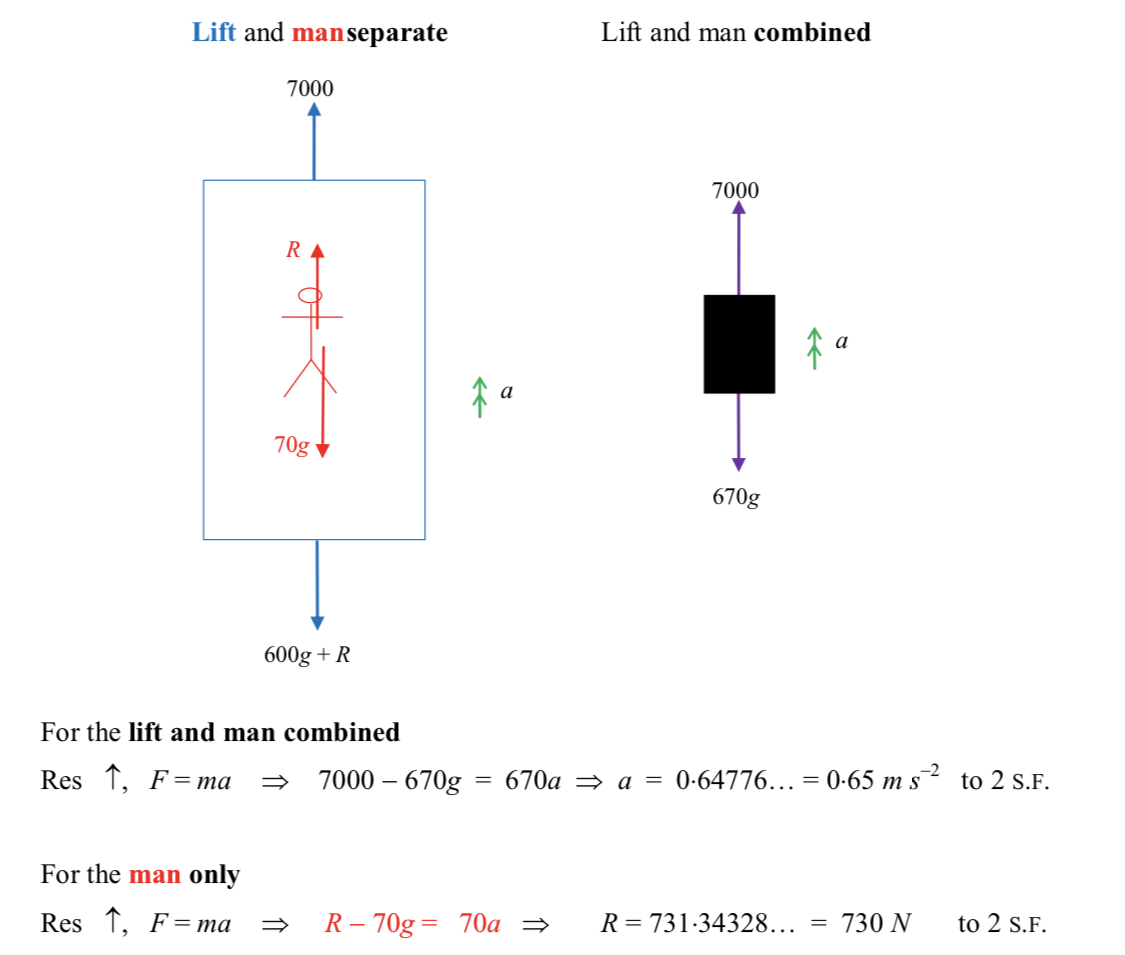
Example: A lift of mass 600 kg is accelerating upwards carrying a man of mass 70 kg. If the
tension in the lift cables is 7000 N find the acceleration of the lift and the force between
the floor and the man’s feet.
Solution: Draw a clear diagram with all forces on lift AND all forces on man.
Draw a second diagram showing the combined system, that is, the man and the lift as
‘one particle’.
N.B. If the normal reaction on the man is R newtons then this means that the lift floor is
pushing up on the man with a force of R newtons,
therefore the man must be pushing down on the lift floor with an equal sized force
of R newtons.
Hint: Draw a LARGE lift and put the man in the middle (not touching the floor).
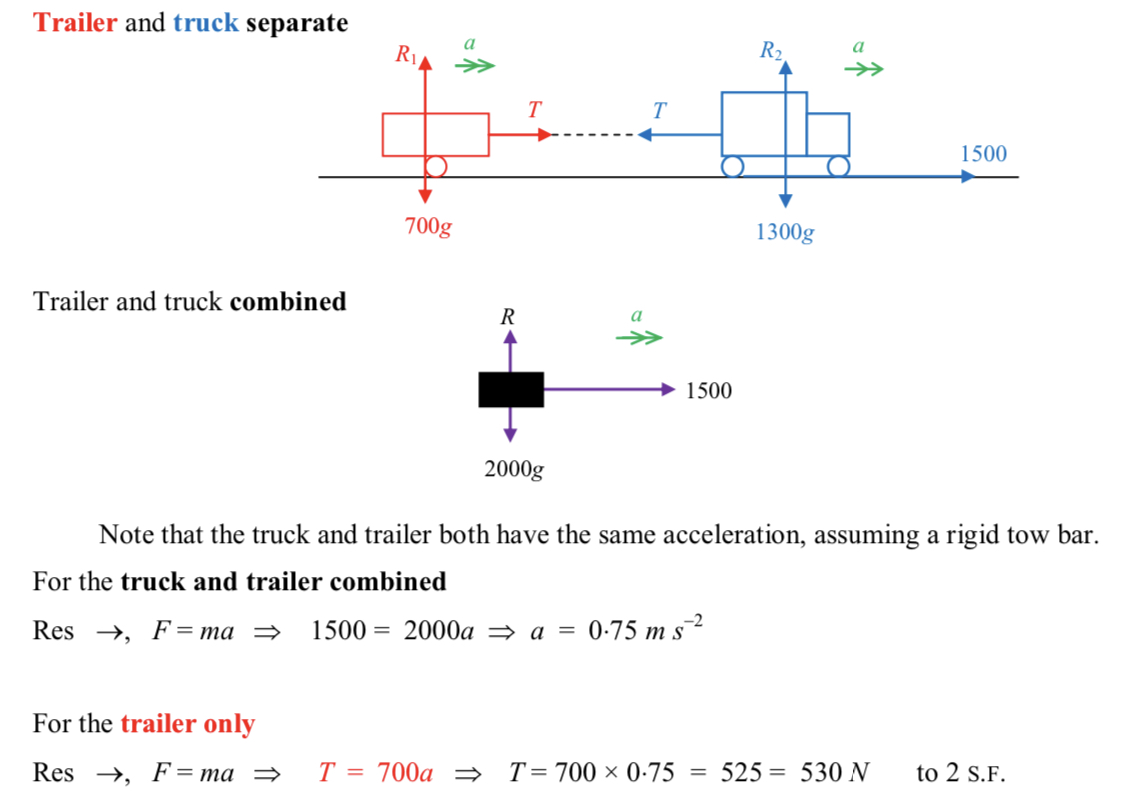
Example: A truck of mass 1300 kg is pulling a trailer of mass 700 kg. The driving force
exerted by the truck is 1500 N and there is no resistance to motion.
Find the acceleration of the truck and trailer, and the force in the tow bar between the
truck and the trailer.
Solution: Draw a clear diagram, separating the truck and the trailer to show the forces on
each one.
Draw a second diagram showing the combined system, that is, the truck and the trailer
as ‘one particle’.
If the force in the tow bar is T N then this force will be pulling the trailer and pulling
back on the truck, since the truck is accelerating.