Friction
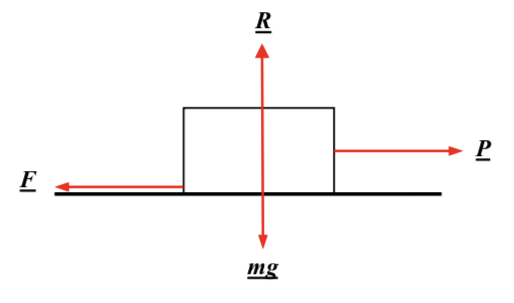
If we try to pull a box across the floor there is a friction force between the box and the
floor.
If the box does not move the friction force will be equal to the force P
and as P increases from 0 N the friction force will also increase from 0 N until it
reaches its maximum value Fmax, after which the box will no longer be in
equilibrium.
When friction force is at its maximum and the box is on the point of moving the box is
said to be in limiting equilibrium.
N.B. The direction of the friction force is always opposite to the direction of motion (or the
direction in which the particle would move if there was no friction).
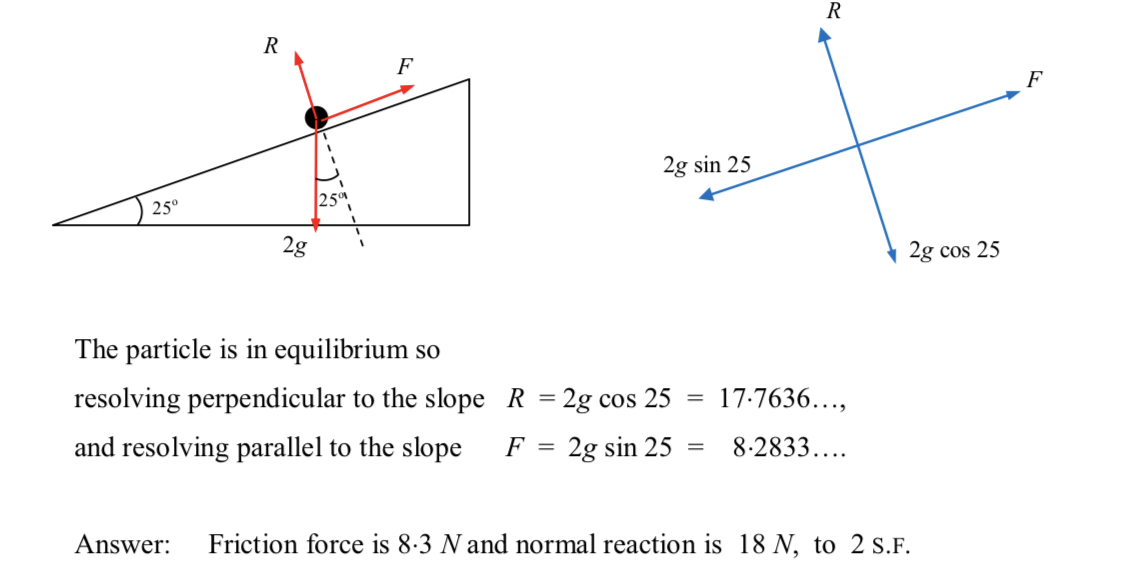
Example: A particle of mass 2 kg rests in equilibrium on a plane which makes an angle of
25o with the horizontal.
Find the magnitude of the friction force and the magnitude of the normal reaction.
Solution: DRAW A DIAGRAM SHOWING ALL FORCES - the weight 2g N, the
friction F N and the normal reaction R N. Remember that the particle would move down
the slope without friction so friction must act up the slope.
Then draw a second diagram showing forces resolved along and perpendicular to the
slope.