
The photoelectric effect as evidence for the particle nature of EM radiation
The photoelectric effect also couldn’t be explained by wave theory as:
1. Wave theory suggests that any frequency of light should be able to cause photoelectric emission as the energy absorbed by each electron will gradually increase with each incoming wave, and so can’t explain the existence of a threshold frequency.
2. The photoelectric effect is immediate, which contradicts wave theory which suggests time is needed for the energy supplied to the electrons to reach the work function (minimum energy required for electrons to be emitted from the surface of a metal).
3. Increasing the intensity of the light does not increase the speed of photoelectric emission as would be suggested by wave theory, but instead it increases the number of photoelectrons released per second.
4. Photoelectrons are released with a range of kinetic energies.
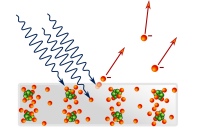
The photon model of EM radiation, which suggests that EM waves are released in discrete packets called photons, which have particle-like interactions, could be used to explain all the points above which wave theory couldn’t:
1. When a photon interacts with an electron, all of its energy is transferred to it, and an electron can only interact with a single photon. If this energy is above the work function, a photoelectron is emitted, if this energy is below the work function, the electron remains in place. As the energy of a photon is directly proportional to frequency (E = hf), the threshold frequency is the frequency at which the photon energy is equal to the work function of the metal.
2. The photon energy is transferred to the electron immediately when they interact, leading to photoelectrons being emitted immediately.
3. Intensity is equal to the number of photons released per second, if this is increased the number of photoelectrons emitted is increased because more photons interact with electrons per second.
4. All electrons will receive the same amount of energy from a photon of light, however electrons which are deeper in the metal will lose energy through collisions when leaving the metal, and will therefore have a lower kinetic energy.