
Pulse-echo technique
The pulse-echo technique is used with ultrasound waves (sounds waves with a frequency greater than 20 kHz) for the imagining of objects, notably for medical imaging. This technique relies on the fact that waves are reflected when they meet boundaries between different materials.
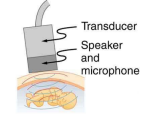
Below is a brief description of the pulse-echo technique:
1. Short pulse ultrasound waves are transmitted into the target (e.g the body in medical imaging).
2. The pulse travels inside the body until it reaches a boundary between two mediums where some of the pulse is reflected back. The amount of reflection depends on the difference in densities of the materials; the greater this difference, the greater the reflection.
3. The reflected waves are detected as they leave the target.
4. The intensities of the reflected waves are used to determine the structure of the target and the time taken for these reflected waves to return is used to determine the position of objects in the target (using s = vt).
If the duration of the pulses is too long, they will likely overlap, meaning that the amount of information you obtain (the resolution of the image) will decrease.
Also, as the wavelength of the waves used increases, the less fine details can be resolved, meaning that amount of information you obtain will decrease.