
Electromotive force and internal resistance
Batteries have an internal resistance (r) which is caused by electrons colliding with atoms inside the battery, therefore some energy is lost before electrons even leave the battery. It is represented as a small resistor inside the battery.
Electromotive force (emf / ε) is the energy transferred by a cell per coulomb of charge that passes through it:

Where E is the energy transferred and Q is the charge.
As you can see in the circuit below, the sum of the internal resistance (r), and load resistance (R) is equal to the total resistance (RT ) in the circuit.
RT = R + r
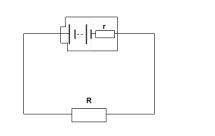
Emf is the product of the total resistance and the current of the circuit, as v = IR.

The p.d across the resistance R, is known as the terminal potential difference (V), whereas the p.d across the resistance r, is known as lost volts (v) because this value is equal to the energy wasted by the cell per coulomb of charge.
V = IR
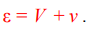
Therefore, emf is the sum of the terminal p.d and lost volts:
The emf of a battery can be measured by measuring the voltage across a cell using a voltmeter when there is no current running through the cell, which means it is in an open circuit.