Determine the Young Modulus of a Material
Equipment
- G-clamp
- Wooden blocks
- Long copper wire
- Tape
- Metre ruler
- Work bench
- 100 g masses
- Pulley
Method
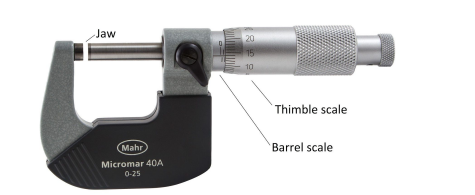
1. Measure the diameter of the wire in 3 different places using a micrometer and record these values (how to use a micrometer is illustrated below).
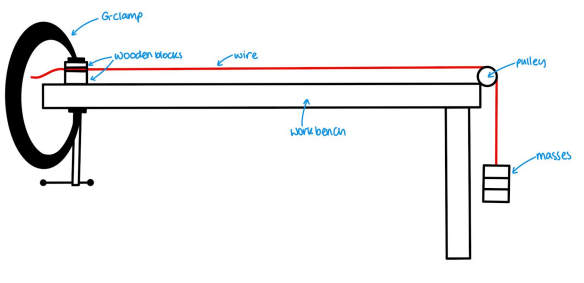
2. Set up the apparatus as shown in the diagram.
3. Attach the metre ruler to the workbench so that the lower end is facing the G-clamp and place a marker on the wire at 0 cm on the ruler.
4. Measure the length of wire from the blocks of wood to the marker on the wire when it is taut.
5. Attach a mass to the wire and record the total mass attached to the end of the wire in kg. The wire will stretch when this mass increases therefore, record the new position of the marker.
6. Add another 100 g mass and once again record the position of the marker - keep doing this
until you have readings for at least 7 different mass values.
Calculations
- Find the mean diameter of the wire and calculate the average cross sectional area using A = πd2/4
- Using F = mg calculate the force exerted on the wire for each mass and record these values in a table.
- Calculate the wire’s extension by finding the difference between the marker’s final position and its initial position for each mass.
- Find the stress for each mass by dividing the force applied by the cross sectional area of the wire.
- Find the strain on the wire for each mass by dividing the extension by the original length of the wire. ΔL
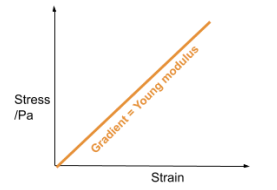
- Plot a graph of stress against strain and draw a line of best fit.
- As the Young modulus = stress/strain, the gradient of the line of
best fit is equal to the Young modulus of copper.
Safety
- You MUST wear protective eyewear, as if the wire snaps and flies out it could seriously injure or blind people near it.
- Place some cushioning under the masses in case the wire snaps, so that they will not
bounce and hit people’s feet if they fall.
Notes
- Make the original length of the wire as long as possible since this will reduce the uncertainty in the measurement of original length.
- Make sure the wire is relatively thin because the thinner the wire, the larger the extension it experiences. A larger extension will reduce the uncertainty in the measurement of extension.
- Try and find the extension for as many masses as possible as more data points allows a better line of best fit to be drawn.
How to Read a Micrometer
1. Place the object to be measured between the jaw of the micrometer.
2. The barrel of the micrometer has two scales, one which is horizontal (barrel scale) and one which is vertical (thimble scale). The barrel scale will give a reading of millimeters and half millimeters.
3. Read the barrel scale by looking at the edge of the micrometer thimble (this is the part that turns), if the thimble is over the 4th millimeter marking after 10 mm, you’re reading 14 mm and if it is on/just over the half millimeter making after 14mm, then the reading is 14.5 mm.
4. For more precise measurements, find where the thimble scale lines up exactly with the axis
of the barrel scale. Each mark on the thimble scale represents 0.01 of a mm. If this is 33
then add 0.33 to the barrel scale reading (14.5 mm) to find the measurement is 14.83 mm.