Particles connected by pulleys
The string will always be inextensible and light and the pulley (or peg) will always be smooth
or light.
1) As the string is inextensible the accelerations of the two particles at its ends will have the
same magnitude.
2) As the string is light, the tension in the string will be constant along its length.
3) As the pulley (or peg) is smooth or light, the tensions in the string on either side of the
pulley (or peg) will be equal.
Example: Particles of mass 3 kg and 5 kg are attached to the ends of a light inextensible
string which passes over a fixed smooth pulley. The 5 kg particle is initially 2 m above the
floor.
The system is released from rest; find the greatest height of the lighter mass above its initial
position in the subsequent motion. Assume that the lighter mass does not reach the pulley.
Solution:
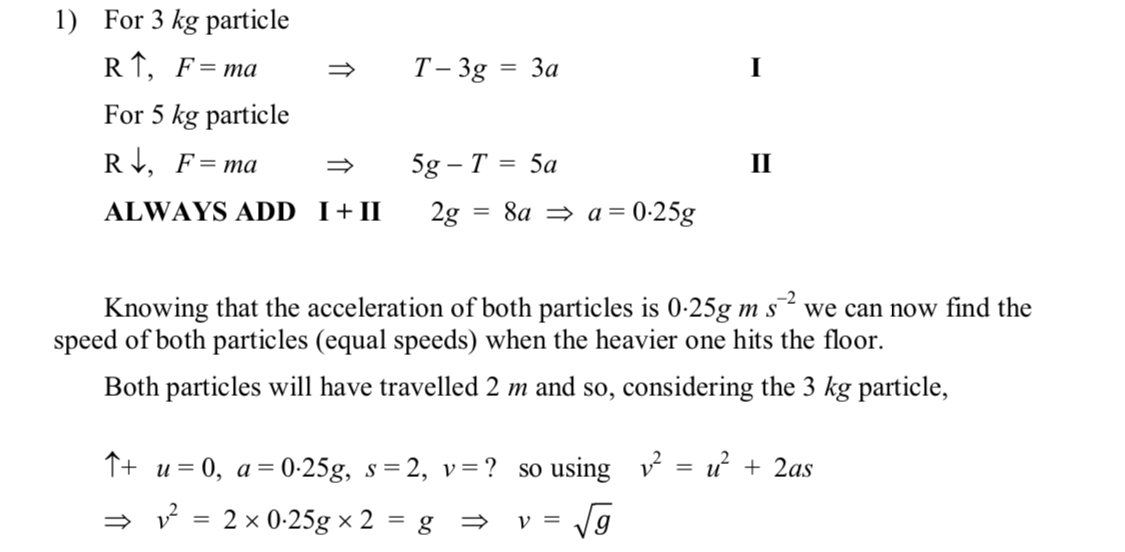
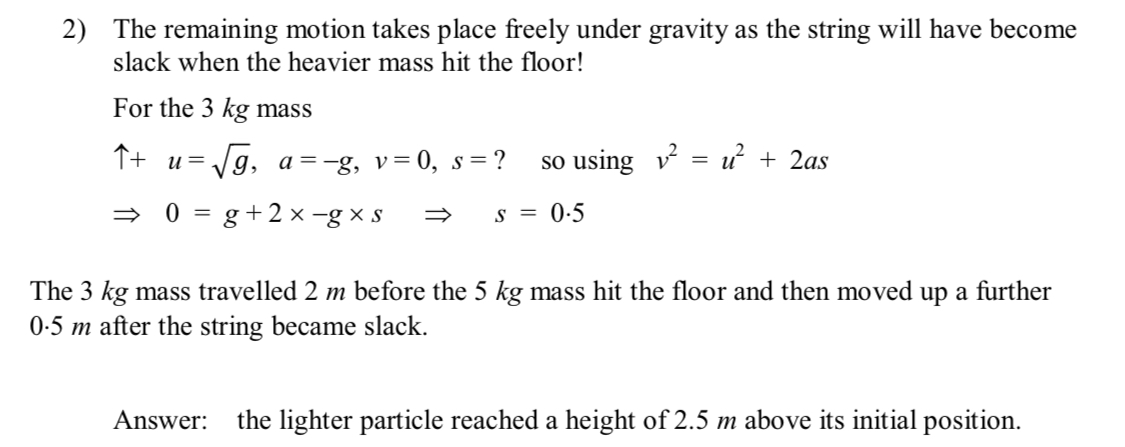
The two particles will move together until the heavier one hits
the floor. Then the string will become slack, and the lighter
particle will move freely under gravity.
Thus, our problem has two distinct parts.
1) What happens before the heavy particle hits the floor?
2) What happens after the heavy particle hits the floor?
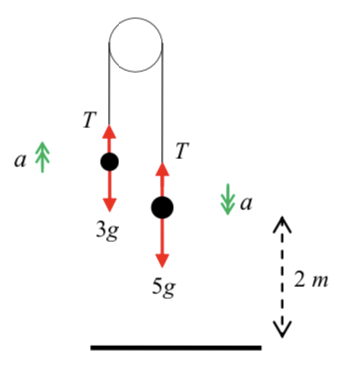
Since the string is inextensible the accelerations of both
particles will be equal in magnitude.
Since the string is light and the pulley is smooth the tensions on both sides will be equal in
magnitude.