Conservation of linear momentum, CLM
If there are no external impulses acting on a system then the total momentum of that system is
conserved (i.e. remains the same at different times).
or total momentum before impact equals total momentum after impact.
Note that if there is an external impulse acting on the system then the momentum
perpendicular to that impulse is conserved.
[image]
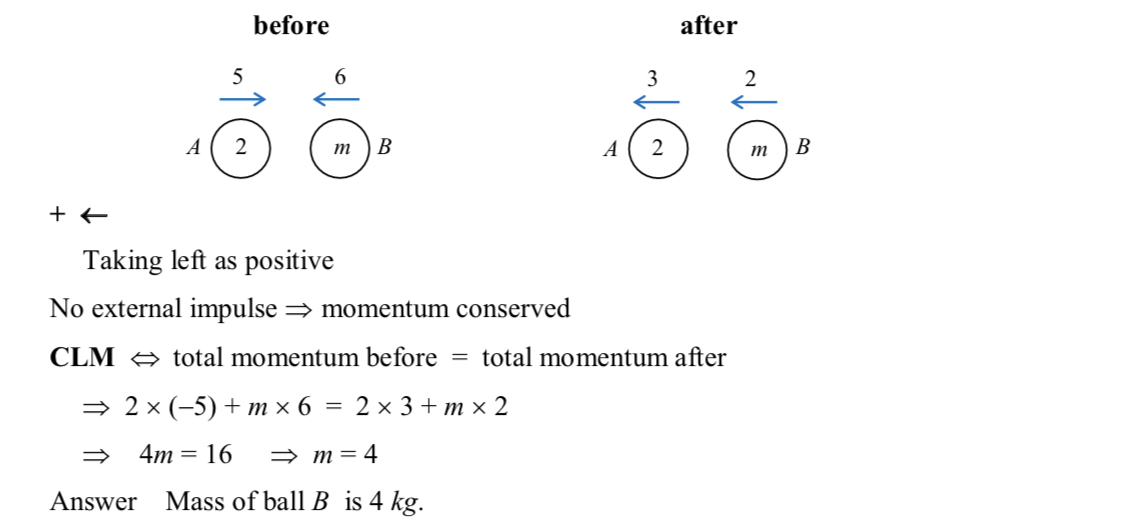
Example: A railway truck of mass 1500 kg is travelling in a straight line at 3 m s-1. A second
truck of mass 1000 kg is travelling in the opposite direction at 5 m s-1. They collide (without
breaking up) and couple together. With what speed and in what direction are they moving
after the impact?
Solution: There is no external impulse (the impulse of gravity is ignored as the time interval
is very short) and so momentum is conserved.
ALWAYS DRAW A DIAGRAM - before and after (and sometimes during)
You must always choose which direction is positive, then take note of the directions of the
arrows in your diagram.
Let the common speed after impact be v ms-1 in the direction of the initial velocity of the
1500 kg truck (if this direction is wrong then v will be negative):
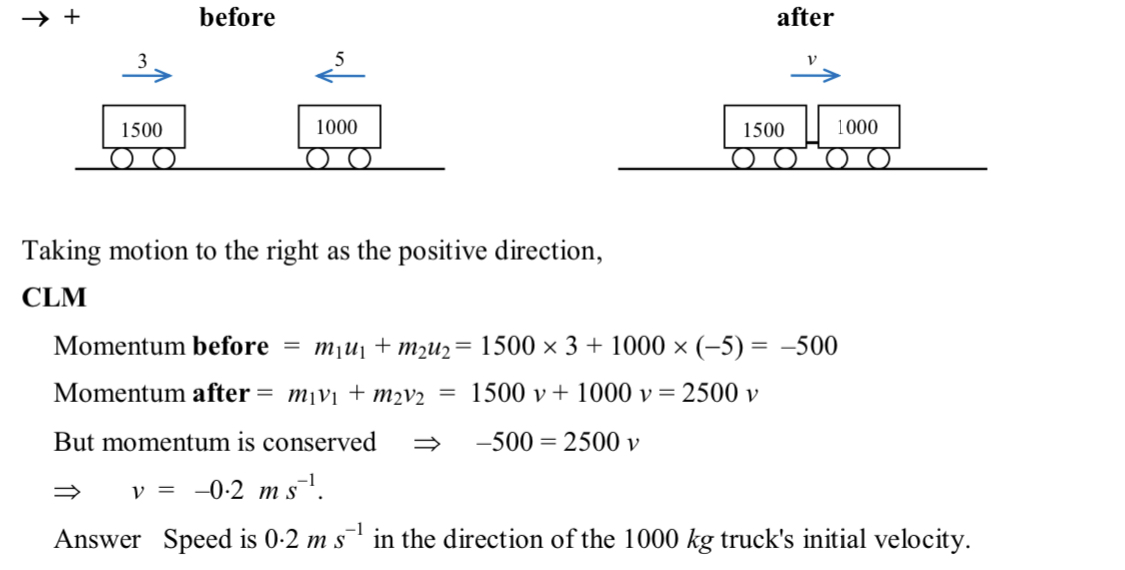
Example: Two balls A and B are travelling towards each other with speeds uA = 5 m s-1 and
uB = 6 m s-1.
After impact A is now travelling in the opposite direction at 3 m s-1, and B continues to
travel in its original direction but with speed 2 m s-1.
The mass of A is 2 kg. Find the mass of B.
Solution: Let the mass of B be m kg.
ALWAYS DRAW A DIAGRAM - before and after (and sometimes during)