
Measuring the refractive index of a solid material
The procedure for finding the refractive index of a solid material is as follows:
1. Place the material in the centre of a piece of paper and draw around it using a pencil.
2. Next, put the material block aside and mark a point on the outline of the material (preferably in the centre) and draw a line perpendicular to the outline at this point (as shown below). This is the normal line. Use a protractor to make sure that the line is at exactly 90° (perpendicular).
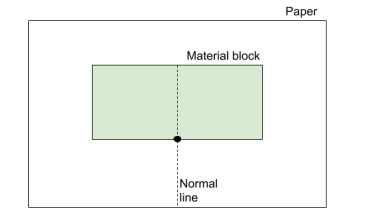
3. Using a protractor, draw lines leaving the point you have marked at 10° intervals from 10° - 70°, where the angle is measured from the normal line to the line you are drawing. These will be the incident rays.
4. Put the material block back, making sure that it fits the outline as well as possible.
5. Using a ray box, shine a ray of line along the 10° line and mark the point at which the light ray leaves the material block.
6. Join the point you have just marked down to the point on the normal line, at which the light ray enters the block. Using a protractor, measure the angle between this line and the normal. This is the angle of refraction.
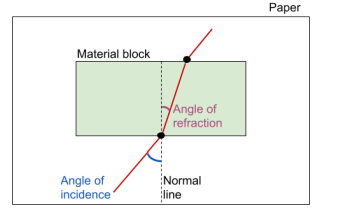
7. Repeat the above two steps for all of the incident angles.
8. Repeat the above method two more times and find the average value of the angle of refraction for each incident angle.
9. Plot a graph of sine of the incident angles (sin i) against sine of the refracted angles (sin r). Plot a line of best fit and find the gradient - this is the refractive index of the material used.
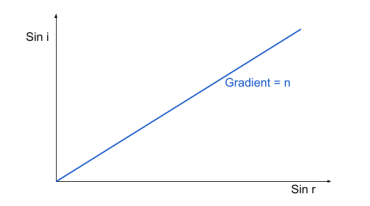
You can derive the above result using snell’s law:

Our initial material is air, which has a refractive index of 1, so the snell’s law equation above can be simplified to:
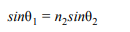
If you replace θ1 (the angle of incidence) with i, θ2 (the angle of refraction) with r, and n2 with n to represent the refractive index of our material, you get:
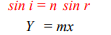
This is simply the equation of the straight line in a graph of sin i against sin r, meaning that its gradient must be n.