Diffraction and Huygens’ construction
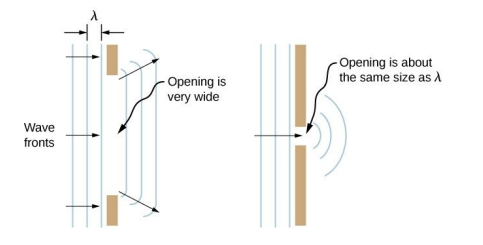
Diffraction is the spreading out of waves when they pass through or around a gap.
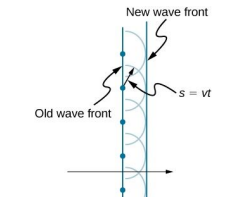
Huygens’ construction states that every point on a wavefront is a point source to secondary wavelets, which spread out to form the next wavefront, as shown in the diagram below:
Huygens’ construction can be used to explain the diffraction of light when it meets an obstacle or passes through a gap.
For example, consider a sound wave travelling through a doorway. From experience, you know that the sound will (probably) be heard throughout the entire room, this is because, as the sound wave travels through the doorway, it diffracts, spreading through the entire room. Diffraction occurs here because each point on the wavefront passing through the doorway (labelled 1 - 5), is a source of wavelets, which spread out from the gap of the doorway forming further circular wavefronts.
In contrast to this, consider light travelling through a doorway. The light passes through the doorway without diffracting much at all, which is why you get straight-edged shadows (as shown in the diagram below).
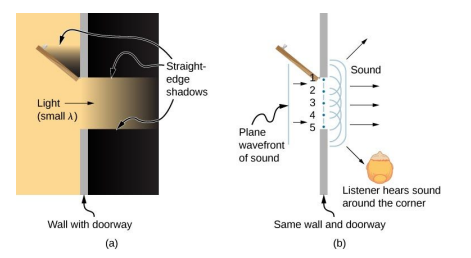
The reason the light waves barely diffract, while the sound waves diffract a lot, is because their wavelength is much smaller in comparison to the size of the doorway. Whereas, the wavelength of the sound wave is much closer to that of the doorway, and the greatest amount of diffraction occurs when the gap is the same size as the wavelength.