
Refractive index and Snell’s law
A refractive index is a property of a material which measures how much it slows down light passing through it. It is calculated by dividing the speed of light in a vacuum (c) by the speed of light in that substance (v).

A material with a higher refractive index can also be known as being more optically dense.
Refraction occurs when a wave enters a different medium, causing it to change direction, either towards or away from the normal depending on the material’s refractive index.
Snell’s law is used for calculations involving the refraction of light:
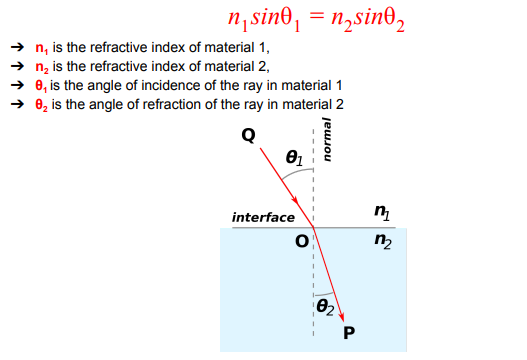
As the light moves across the boundary of the two materials, its speed changes, which causes its direction to change.
In the example above, n2 is more optically dense than n1 , therefore the ray of light slows down and bends towards the normal. However, in the case where n2 is less optically dense than n1 the ray of light will bend away from the normal.